
~/research / monolith-vs-agentic-systems
Monolith vs Agentic Systems
Why marketing software is moving from one monolithic platform to a system of specialised agents — and what changes for the buyer.
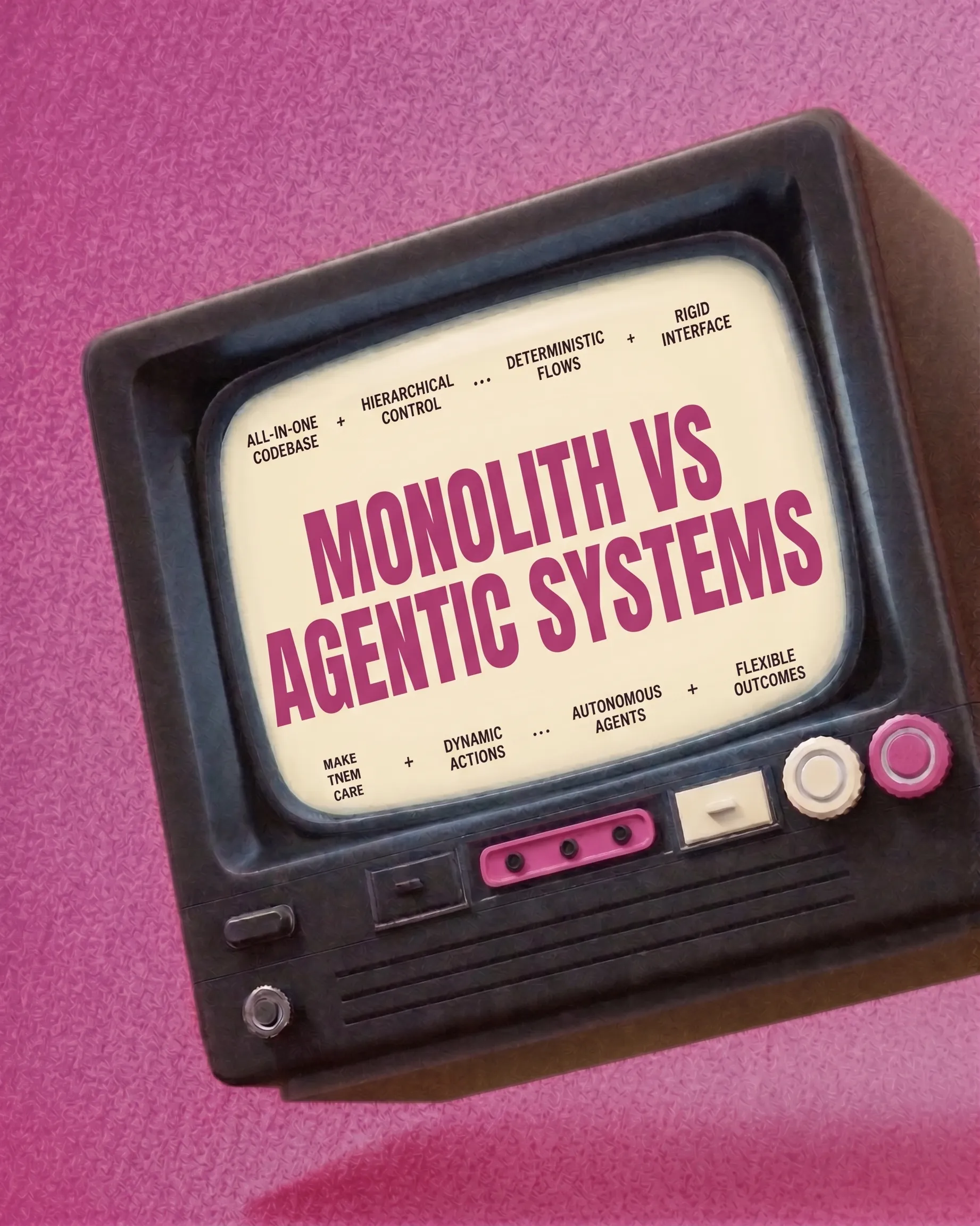
Why marketing software is moving from one monolithic platform to a system of specialised agents — and what changes for the buyer.
Marketing software is moving from one monolith to a system of specialised agents that share a memory layer. The reason is structural. A monolith spreads itself across acquire, nurture, and retain and goes shallow on all three. Specialised agents go deep on one motion each, and they compound when they share what they learn. The architecture is the product decision.
One platform that owns the whole lifecycle sounds like consolidation. What you actually buy is an average. The ad-buying module is competent. The personalisation module is competent. The retention module is competent. None of them is the best tool you could run for that motion, because no team builds a world-class media buyer, a world-class creative engine, and a world-class CX layer in the same codebase on the same roadmap.
So buyers route around the monolith. They bolt on a point tool for the motion that matters most this quarter, the stack fragments again, and the thing sold as one platform becomes one more box in a diagram of seven. The seams move; they do not disappear.
The handoff is where a fragmented stack leaks context, and that failure is the spine of two companion pieces: Build Loops, Not Apps traces it through the open feedback loop, and The AI-Native Marketing Playbook traces it through bolt-on AI. This piece carries a different point. Swapping a monolith for a roster of best-in-class specialists fixes nothing if each specialist keeps its own notebook.
A panel of experts who never compare notes is still a fragmented stack with a nicer login. The audience an ad won never reaches the nurture flow that would have converted it. The customer who converted never feeds the campaign that wins the next one like them. Better tools, same broken seam.
The agentic answer is two parts, and both matter. First, an agent per motion. The acquisition engine ElevateOS runs media and creative. Konne runs nurture. Snype runs retention and personalisation. Each is expert at its job, not passable at three.
Second, and this is the part a tool roster misses, the agents write to one memory. A shared context layer holds brand rules, audience history, and what every prior cycle taught. An agent that knows your brand reads from a memory the last campaign wrote to, rather than starting from a fresh prompt. Specialists plus that memory compound. Specialists without it do not.
The buyer stops buying capability and starts buying coordination. A monolith asks you to accept its ceiling on every motion. An agentic system asks one harder question: does the memory hold, and do the agents act on it.
The proof is in the motions run deep. On acquisition, Wonderchef moved one SKU from 0.05× to 3.09× ROAS and booked ₹29.7L in 90 days; Bombay Shaving Co. hit 68% creative approval with brand rules sitting inside the engine. With Snype personalisation at scale, PolicyBazaar ran personalisation to 100M+ creatives in seven languages and lifted CTR 40%, and Bajaj Pulsar turned one selfie into 160K personalised films at 70% click-to-conversion. Same memory, different specialists, each at full depth.
The monolith was the right architecture when integration was the hard problem. Coordination is the hard problem now, and the system that remembers is the one that gets sharper every cycle you run it.
Published 2026-05-06 · Whilter.AI