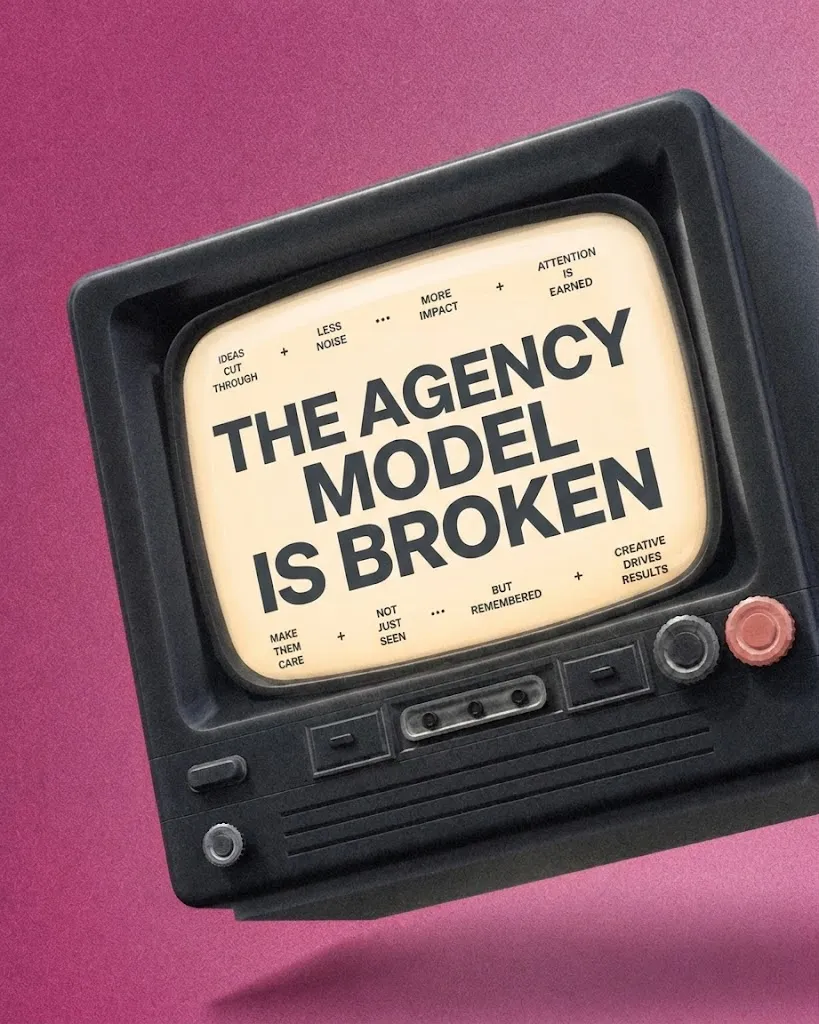
The traditional agency model was built for a world of scarce creative. When making an ad was slow and expensive, it made sense to outsource it to a specialist shop that billed per asset, per round. That world is gone. The model that served it has not caught up.
The argument
The agency model is broken because its incentives point away from your outcome. An agency bills per asset and per round of revisions, on its own production timeline. That means its revenue grows when work takes longer and requires more assets — the opposite of what a performance marketer wants. Brand compliance is reviewed after the fact, in a feedback loop measured in days. Optimisation is periodic and manual, surfaced in a monthly report rather than acted on in real time. The structure decouples cost from outcome: you pay for activity, not for results.
The deeper problem is the hand-off itself. Every brief leaves your building, gets re-interpreted, comes back, and gets re-litigated against the brand. The latency is not a bug in a particular agency — it is the model. No amount of account-management polish removes the baton exchange between your strategy and someone else’s queue.
The evidence
When the queue becomes a system, the economics invert. Run as a connected engine, a single account can generate 40 to 60 brand-compliant variants per campaign at a marginal cost per variant, launch them in under 30 minutes rather than waiting weeks for a studio, and refresh creative on a 7 to 14 day cadence instead of a quarterly review.
The outcome follows the structure. Wonderchef moved from waiting on assets to testing winners every week and saw an 8× ROAS turnaround with +166% link CTR in 90 days — and in the words of their Chief Business Officer, Amit Phutane, “Whilter Elevate didn’t just give us more creative — it gave us a system.” That is the tell. The win was not better creative from a better agency; it was a different operating structure.
The implication
This does not mean talent is worthless — it means the container for talent is wrong. The strategist, the brand custodian, the performance lead all still matter. But they should operate a system they own, where brand rules are enforced inside the engine and the optimisation loop is always on, rather than briefing an external queue and waiting.
The question for a marketing leader is no longer “which agency?” It is “queue or system?” The agencies that survive will be the ones that stop billing per asset and start operating engines. The brands that win will be the ones that bring the engine in-house and let it compound. Either way, the per-asset, per-round, hand-off model is finished — it just hasn’t been told yet.