~/research / build-loops-not-apps
Build Loops, Not Apps
The 2026 shift: static apps give way to closed loops that learn every cycle. The loop is the new unit of marketing software.
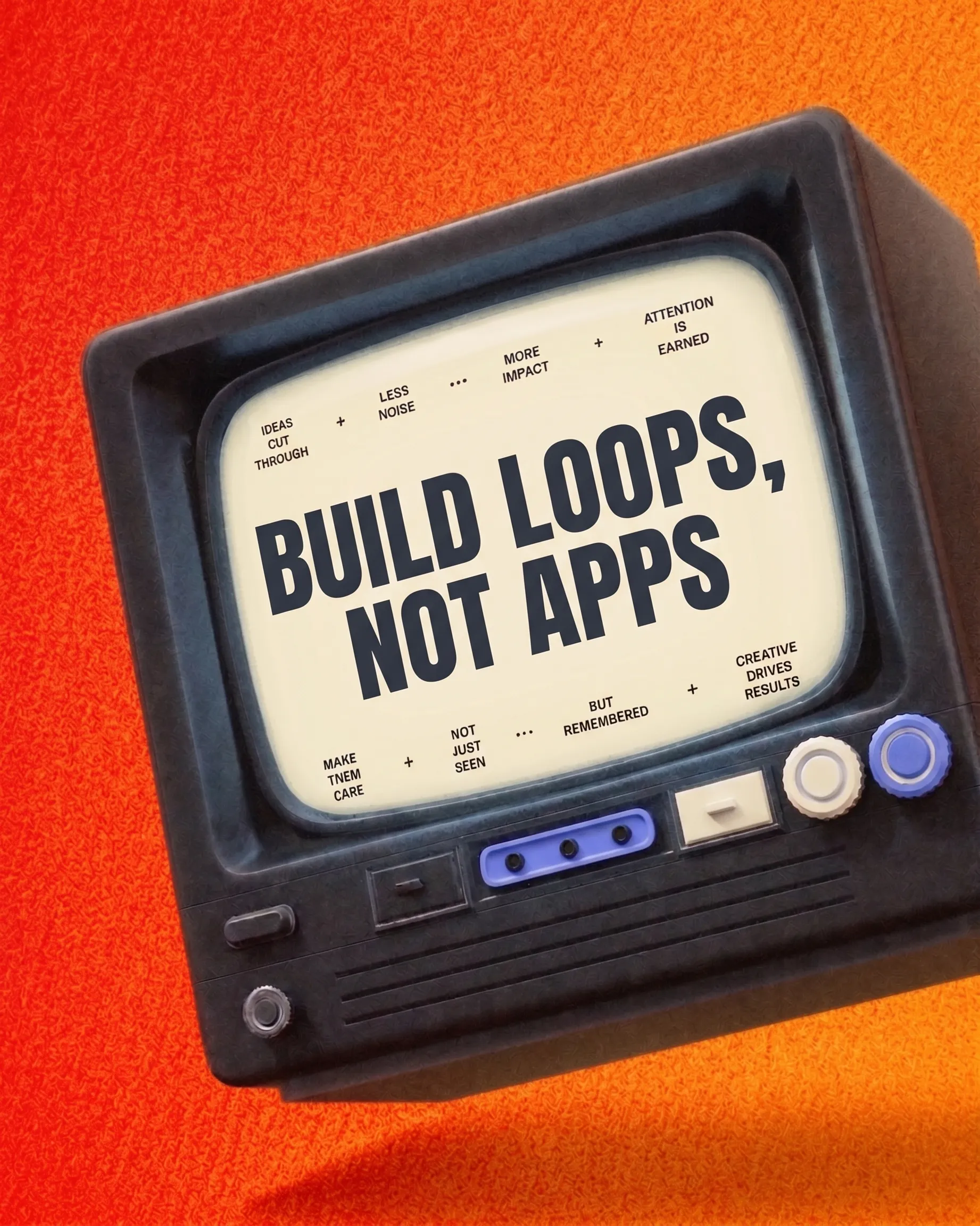
The 2026 shift: static apps give way to closed loops that learn every cycle. The loop is the new unit of marketing software.
The unit of marketing software is changing. For a decade it was the app, a feature you shipped that ran the same way forever. In 2026 it is the loop: generate, measure, feed back, run again. An app executes a fixed instruction. A loop rewrites its own instruction each pass.
A loop is three moves wired into a cycle. Generate a creative, a variant, a journey. Measure what it did against live signal. Feed the result back into the system that makes the next one. Then run it again, now informed by the last pass.
Most stacks skip the third move. A tool generates and reports, then the operator carries the lesson by hand into next week’s brief. The signal never reaches the thing that produces the work, so the loop stays open and nothing accrues. Close it, and each cycle leaves the system smarter than it found it. That accrual is the whole case for why intelligence compounds when the loop is held shut.
Think of the loop as the atom of the product, the smallest thing worth shipping. A vendor selling you a feature is selling you an app: it does one job at a fixed level. A vendor selling you a loop is selling you a slope, where output on a later cycle depends on every cycle before it.
The hard part is not generation. Plenty of vendors generate at volume. The hard part is the write-back, a memory layer that holds what worked per brand and per category and routes it into the next generation. Skip that layer and you have shipped a faster app. Build it and you have shipped a loop. Architecture decides which one you own; the size of the model barely matters.
When the unit is a loop, a write-off becomes a starting point. Wonderchef had a SKU stuck at 0.05× ROAS, a line the team had nearly abandoned. The product did not change and the audience did not change. A closed loop ran it, and the SKU climbed to 3.09× ROAS. At the account level the same cycle drove an 8× ROAS turnaround and +166% link CTR in 90 days (Wonderchef, on ElevateOS, the acquisition engine). The full read of how that compounds sits in intelligence compounds.
Wonderchef had a SKU stuck at 0.05× ROAS, a line the team had nearly abandoned. A closed loop ran it, and the SKU climbed to 3.09× ROAS.
— same product · same audience · loop closed
The lesson for buyers is narrow. The win was not one lucky creative. It was a unit of software designed to improve on its own output, cycle after cycle.
A loop only earns its slope when one system owns all three moves. Split them across an agency that makes the creative, a tool that measures it, and an in-house team that writes the next brief, and the context resets at every border. Three owners, three tools, three places the signal can evaporate.
The fix is to hold the brief, the live result, and the memory in one place, operated by AI agents that know your brand running acquisition, nurturing and retention as one connected engine. That single-owner pattern repeats across the case library, from top-of-funnel acquisition through retention, wherever one system carries the cycle end to end.
By 2027 the question for any marketing system will not be what it ships. It will be how fast its loop closes.
Published 2026-06-20 · Whilter.AI